Door hardware fails in boring ways: loose levers, squeaky hinges, latches that need a second push. All of it traces back to two things — buying the wrong size for the door, or buying hollow hardware. Here is how to get both right the first time.
Measure the Backset First
The backset is the distance from the edge of the door to the center of the bore hole. US doors come in two standards: 2-3/8 inches and 2-3/4 inches. Measure yours before ordering anything — our privacy door knob and satin nickel door lever are built for those two standards respectively, and the spec sheet on every door product explains the measurement in one diagram.
While you are measuring: door thickness. Standard doors run 1-3/8 to 1-3/4 inches, and every passage set covers that range. If your door is something unusual — an old solid-core door, a barn conversion — measure it and check the specs before ordering.
Passage, Privacy, Entry: What the Functions Mean
- Passage — no lock; hall and closet doors.
- Privacy — lockable from inside with a push button or turnpiece; bedrooms and bathrooms. That is what our keyless privacy knob provides.
- Entry — keyed or electronic; front and side doors.
For entry doors, the modern default is the electronic lock. Our smart door lock handles fingerprint, keypad and app entry, fits both standard backsets, and — the detail that matters — is rated for exterior use. Check that rating on any smart lock: interior-rated electronics fail fast on a front door.
Hinges: The Part Everyone Forgets
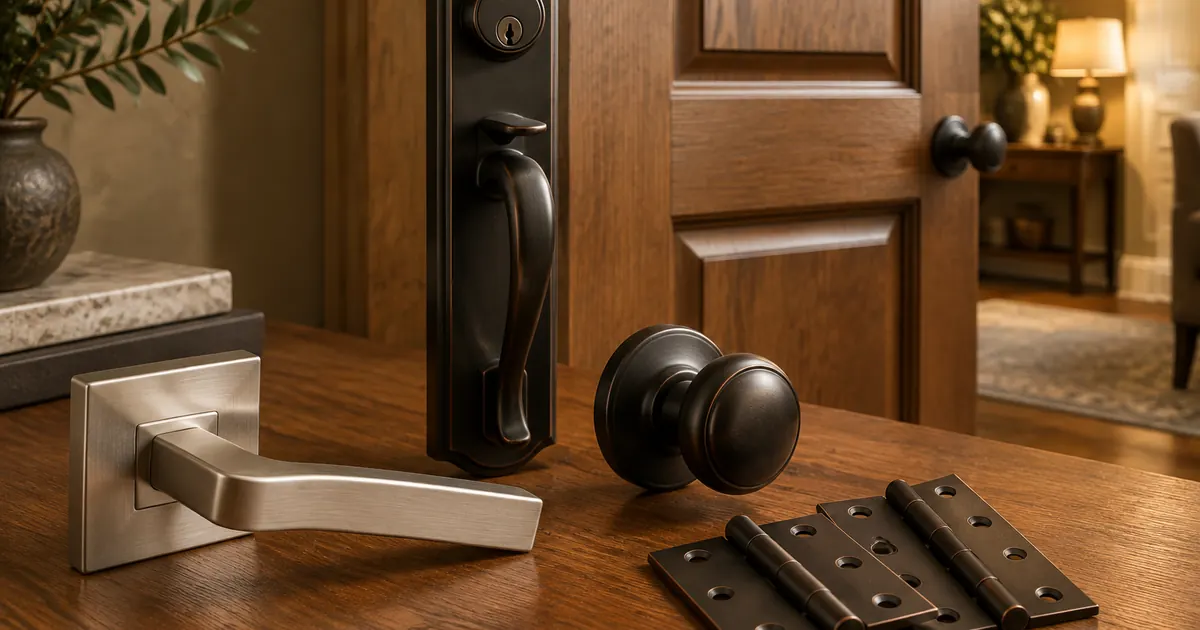
A $200 lever on a squeaky hollow hinge is a $20 experience. Hinges decide how a door feels — the smooth, silent swing of a quality door is almost always ball-bearing hinges doing their job. Our steel ball-bearing hinge carries the door's weight on bearings instead of a bare pin, which eliminates squeak and, more importantly, sag. Match the hinge finish to your lever and the door stops being two hardware decisions and becomes one.
Count your hinges too: doors up to 60 pounds need two; anything heavier, or any door in a high-humidity area, needs three.
The Barn Door Exception
Barn doors use none of the above — they hang from rollers. What matters is the track quality and the weight rating. Our steel barn door kit uses heavy-duty rollers on a 6-foot track, which is the difference between a door that glides silently and one that announces every passage. Mount the track into studs or blocking; drywall anchors alone will eventually pull out under a swinging door's leverage.
Small Hardware, Real Difference
Door stops and coat hooks are the finishing touches. A floor-mounted door stop with a rubber base protects both the door and the wall behind it — skip it and the doorknob eventually punches a hole in the drywall. Cast iron coat hooks by the entry take winter coats without flexing.
The Five-Minute Checklist
- Measure backset and door thickness.
- Decide the function per door: passage, privacy, entry.
- Pick one finish family and stay in it.
- Upgrade hinges — ball-bearing, finish-matched.
- Add stops and hooks where doors meet walls.
Strike Plates: The Cheapest Security Upgrade
The strike plate is the metal piece on the door frame where the latch lands — and it is the difference between a door that holds and one that fails in a kick. Most builder plates are held by half-inch screws into soft wood. Upgrade to a plate with three-inch screws that reach the wall stud behind the frame, and the door stops being the weak point. It is a five-dollar, ten-minute upgrade that outperforms every security gadget on the market, and it applies to every exterior door in the house.
Finishes and the View From Inside
Door hardware is the one category where you see the inside face every day and the outside face rarely. Levers and knobs should match the room they open into: satin nickel in a bathroom with chrome fixtures reads as a mistake; matching it to the room's own finishes reads as intentional. Our satin nickel lever and oil-rubbed bronze handle set cover the two most common home palettes — cool and warm respectively — and both age well with daily contact.
Sound: The Underrated Spec
Close your eyes and open a good door. You hear almost nothing — the latch retracts smoothly, the hinge is silent, the catch lands soft. That silence is the sum of three parts: ball-bearing hinges, a solid latch, and a strike plate aligned within a millimeter. When a door "feels expensive," that is what you are hearing. Every part in that chain is replaceable in an afternoon, and the parts cost less than dinner out.
When to Repair and When to Replace
Loose lever: tighten the set screw (usually a tiny hex key under the lever arm) — five minutes. Squeaky hinge: work a drop of oil into the pin and swing the door a dozen times. Latch that needs a shove: the strike plate has drifted; loosen, realign, retighten. Replace when the finish has worn through, the latch sticks even after realignment, or the internals rattle — hollow hardware reveals itself by sound long before it fails by function.
A Note on Exterior Doors
Exterior door hardware lives in weather, and weather is the real durability test. Oil-rubbed bronze and PVD finishes handle four-season climates; painted finishes blister within a few years. Whatever you choose, the rust-resistant ball-bearing hinges matter more outside than in — a rusted hinge on a front door is the hardware equivalent of a flat tire.